Medical devices / invention and transfer
From mechanism
to product handoff.
Biopsy-device invention sits alongside prototype testing, physician support, training and acquisition transfer. The role history describes that work; the granted records below describe the mechanisms and credit their inventors.
Career / 2012–2022
Testing, support and transfer.
Employment dates belong to the roles. Filing and grant dates belong to the records; a later grant does not extend an employment period.
Product Manager
Invented biopsy technology associated in the role history with US 9,463,002 B2 and US 10,004,483 B2. Provided troubleshooting during complex procedures, trained and supported physicians and 50+ sales representatives, and designed and ran the trade-show booth.
US Biopsy was acquired by Argon Medical Devices.
Product Specialist
Transitioned commercialized product lines to the Argon sales team through the acquisition. Supported sales representatives nationwide before, during and after procedures, and conducted regional product training.
Product Manager / Co-Founder
Invented biopsy technology and worked directly with a patent attorney. Designed, conducted and analyzed in vivo and benchtop testing with prototype devices to finalize specifications.
Assisted the successful exit and transfer of technology to the Mermaid Medical team.
Career responsibilities are drawn from the homepage’s expanded Experience. The patent records retain each inventor’s credited name; they do not divide the inventive work among those people.
Records / 2016–2025
Five U.S. grants.
Each record has its own filing date, grant date and inventor list. These are five grants, with a recorded continuation relationship between the 2023 and 2025 records.
- Oct. 11, 2016US 9,463,002 B2
- Jun. 26, 2018US 10,004,483 B2
- Jun. 29, 2021US 11,045,173 B2
- Dec. 12, 2023US 11,839,364 B2
- Mar. 4, 2025US 12,239,299 B2
The 2025 record is a continuation of the 2023 record. Their abstracts are identical; separate grants do not establish independent inventions or explain differences in the claims.
Read a mechanism summary, expand the unchanged abstract, then inspect the granted document. Previous/next buttons, the page map and arrow keys navigate the images. Open an image for its full size. With JavaScript off, each first page and the abstracts remain available.
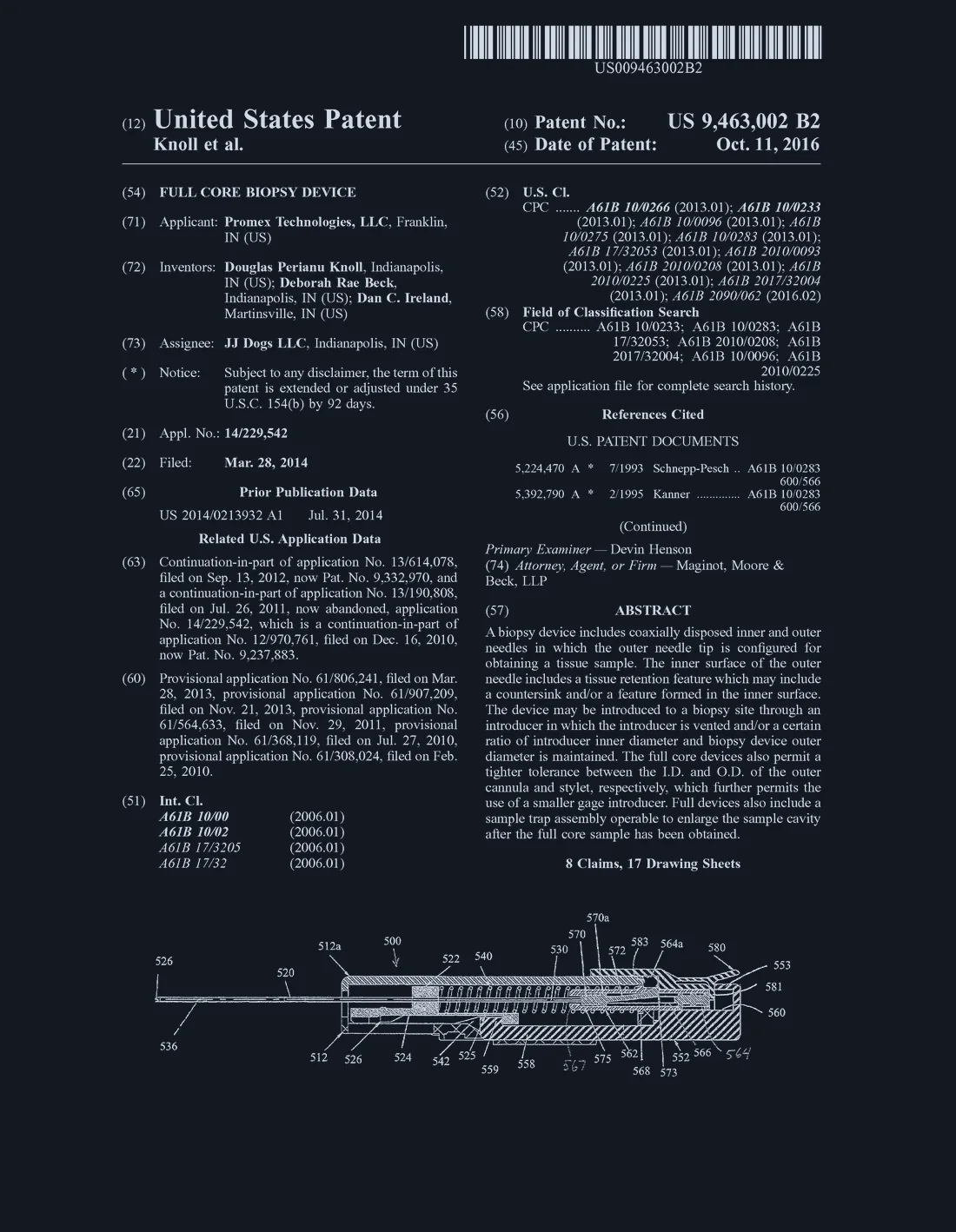
US 9,463,002 B2
FULL CORE BIOPSY DEVICE
Mechanism / explanatory paraphrase
Inner and outer needles share an axis. The outer needle describes a tissue-retention feature; the disclosure also addresses introducer venting or diameter proportions and a sample trap that can enlarge the sample cavity after collection.
- Filed
- Mar. 28, 2014
- Granted
- Oct. 11, 2016
- Inventors
- Douglas Perianu Knoll, Indianapolis, IN (US); Deborah Rae Beck, Indianapolis, IN (US); Dan C. Ireland, Martinsville, IN (US)
- Assignee
- JJ Dogs LLC, Indianapolis, IN (US)
Abstract, as granted
A biopsy device includes coaxially disposed inner and outer needles in which the outer needle tip is configured for obtaining a tissue sample. The inner surface of the outer needle includes a tissue retention feature which may include a countersink and/or a feature formed in the inner surface. The device may be introduced to a biopsy site through an introducer in which the introducer is vented and/or a certain ratio of introducer inner diameter and biopsy device outer diameter is maintained. The full core devices also permit a tighter tolerance between the I.D. and O.D. of the outer cannula and stylet, respectively, which further permits the use of a smaller gage introducer. Full devices also include a sample trap assembly operable to enlarge the sample cavity after the full core sample has been obtained.
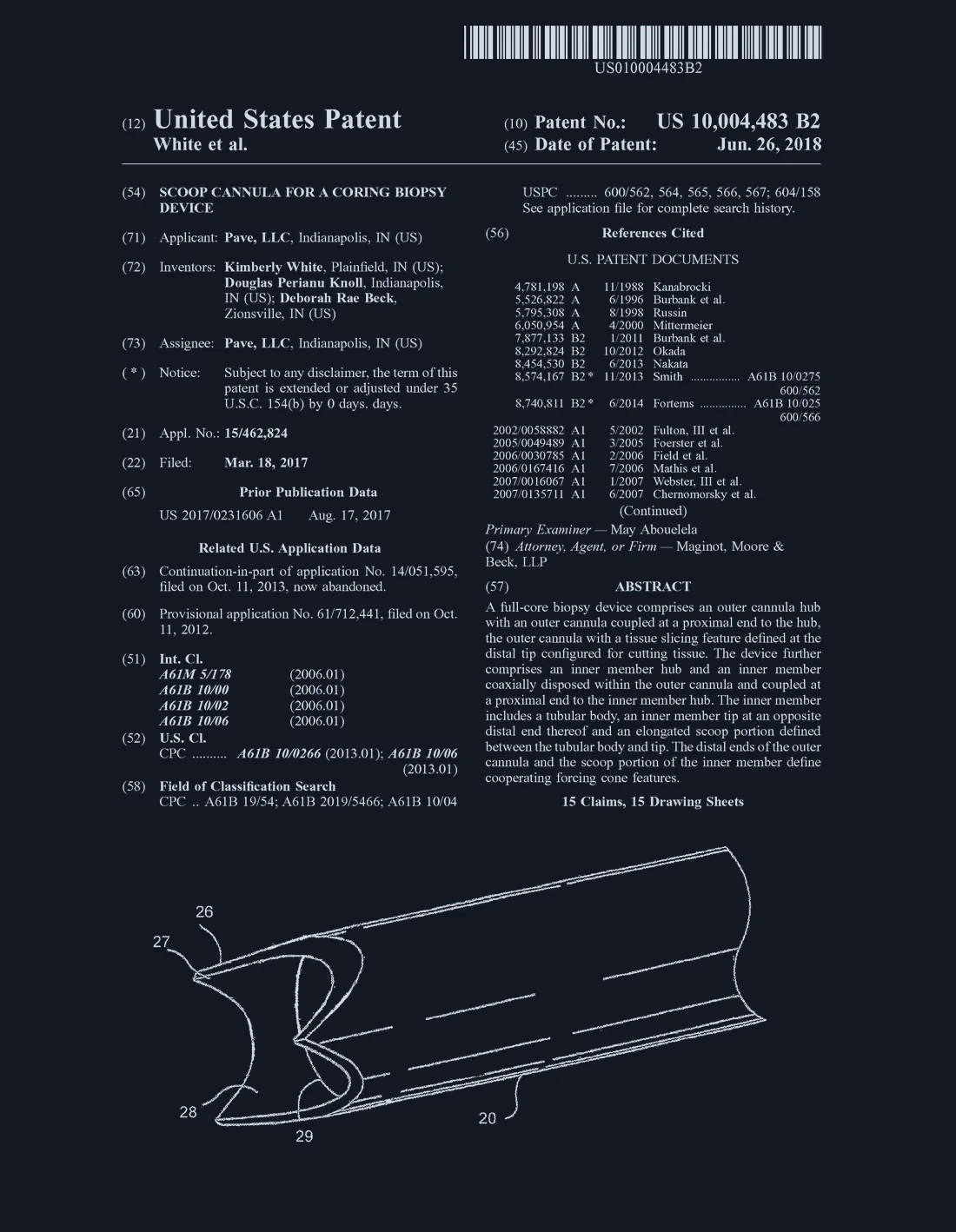
US 10,004,483 B2
SCOOP CANNULA FOR A CORING BIOPSY DEVICE
Mechanism / explanatory paraphrase
An outer cannula provides the tissue-cutting tip. Inside it, an elongated scoop sits between the inner member’s tubular body and tip. The scoop and outer cannula have cooperating forcing-cone features at their distal ends.
- Filed
- Mar. 18, 2017
- Granted
- Jun. 26, 2018
- Inventors
- Kimberly White, Plainfield, IN (US); Douglas Perianu Knoll, Indianapolis, IN (US); Deborah Rae Beck, Zionsville, IN (US)
- Assignee
- Pave, LLC, Indianapolis, IN (US)
Abstract, as granted
A full-core biopsy device comprises an outer cannula hub with an outer cannula coupled at a proximal end to the hub, the outer cannula with a tissue slicing feature defined at the distal tip configured for cutting tissue. The device further comprises an inner member hub and an inner member coaxially disposed within the outer cannula and coupled at a proximal end to the inner member hub. The inner member includes a tubular body, an inner member tip at an opposite distal end thereof and an elongated scoop portion defined between the tubular body and tip. The distal ends of the outer cannula and the scoop portion of the inner member define cooperating forcing cone features.
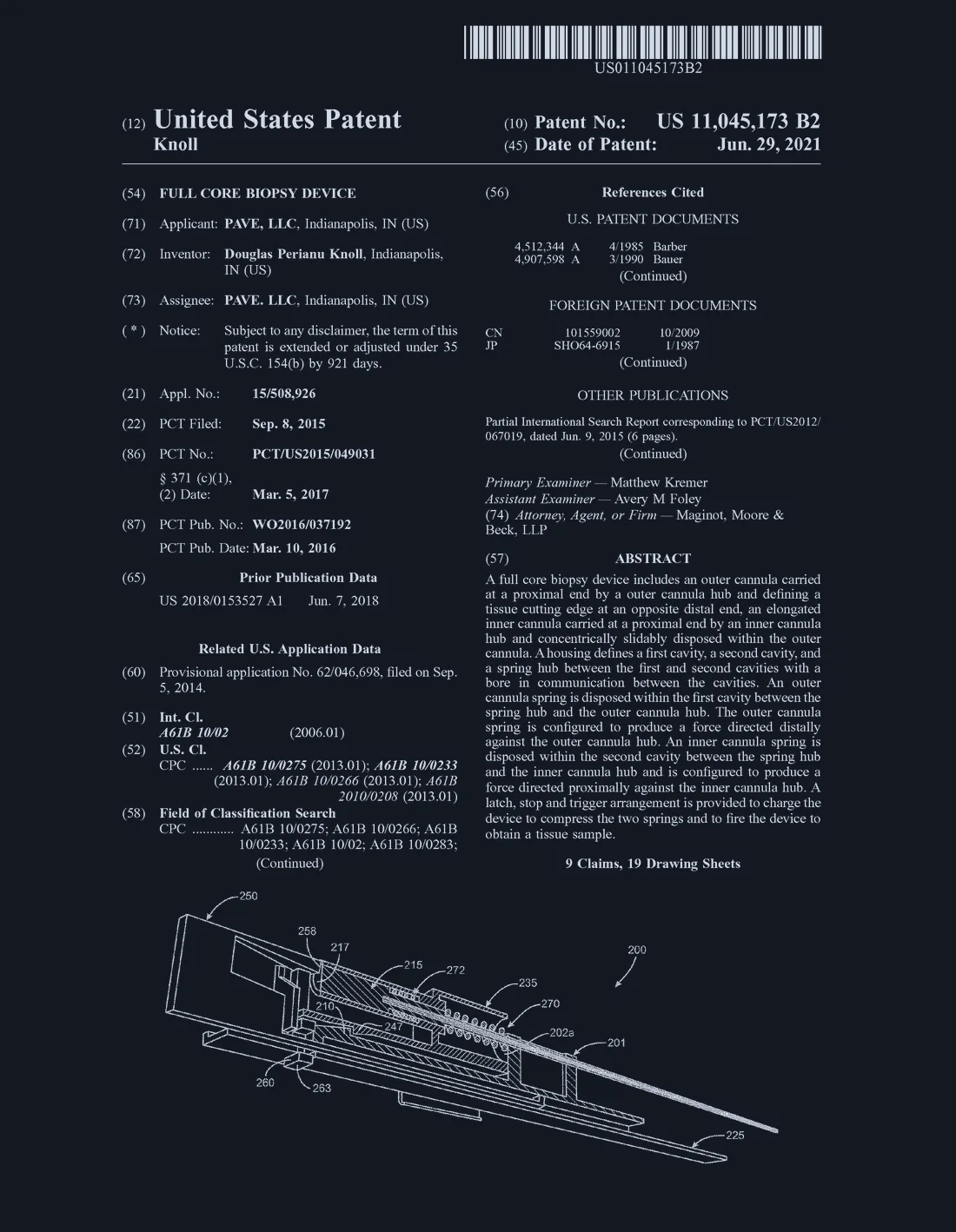
US 11,045,173 B2
FULL CORE BIOPSY DEVICE
Mechanism / explanatory paraphrase
Separate springs act on the outer and inner cannula hubs in opposite directions. A latch, stop and trigger arrangement compresses those springs when charging the device and releases the mechanism to obtain a tissue sample.
- Filed
- Sep. 8, 2015 (PCT)
- Granted
- Jun. 29, 2021
- Inventor
- Douglas Perianu Knoll, Indianapolis, IN (US)
- Assignee
- PAVE, LLC, Indianapolis, IN (US)
Abstract, as granted
A full core biopsy device includes an outer cannula carried at a proximal end by a outer cannula hub and defining a tissue cutting edge at an opposite distal end, an elongated inner cannula carried at a proximal end by an inner cannula hub and concentrically slidably disposed within the outer cannula. A housing defines a first cavity, a second cavity, and a spring hub between the first and second cavities with a bore in communication between the cavities. An outer cannula spring is disposed within the first cavity between the spring hub and the outer cannula hub. The outer cannula spring is configured to produce a force directed distally against the outer cannula hub. An inner cannula spring is disposed within the second cavity between the spring hub and the inner cannula hub and is configured to produce a force directed proximally against the inner cannula hub. A latch, stop and trigger arrangement is provided to charge the device to compress the two springs and to fire the device to obtain a tissue sample.
US 11,839,364 B2
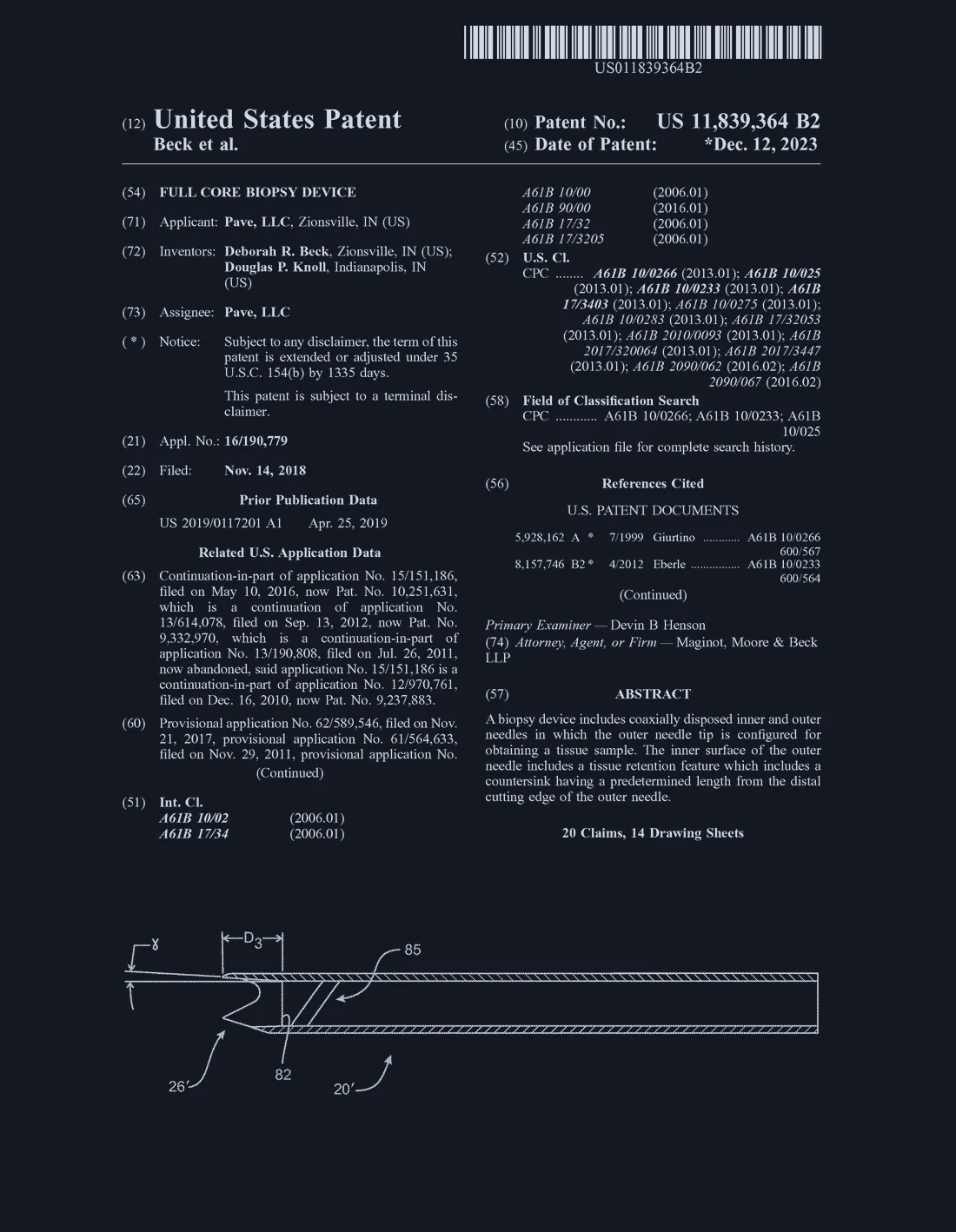
FULL CORE BIOPSY DEVICE
Mechanism / explanatory paraphrase
The outer needle’s inner surface includes a tissue-retention feature: a countersink extending a predetermined length from the distal cutting edge. Inner and outer needles share an axis.
- Filed
- Nov. 14, 2018
- Granted
- Dec. 12, 2023
- Family
- Continued in US 12,239,299
- Inventors
- Deborah R. Beck, Zionsville, IN (US); Douglas P. Knoll, Indianapolis, IN (US)
- Assignee
- Pave, LLC
Abstract, as granted
A biopsy device includes coaxially disposed inner and outer needles in which the outer needle tip is configured for obtaining a tissue sample. The inner surface of the outer needle includes a tissue retention feature which includes a countersink having a predetermined length from the distal cutting edge of the outer needle.
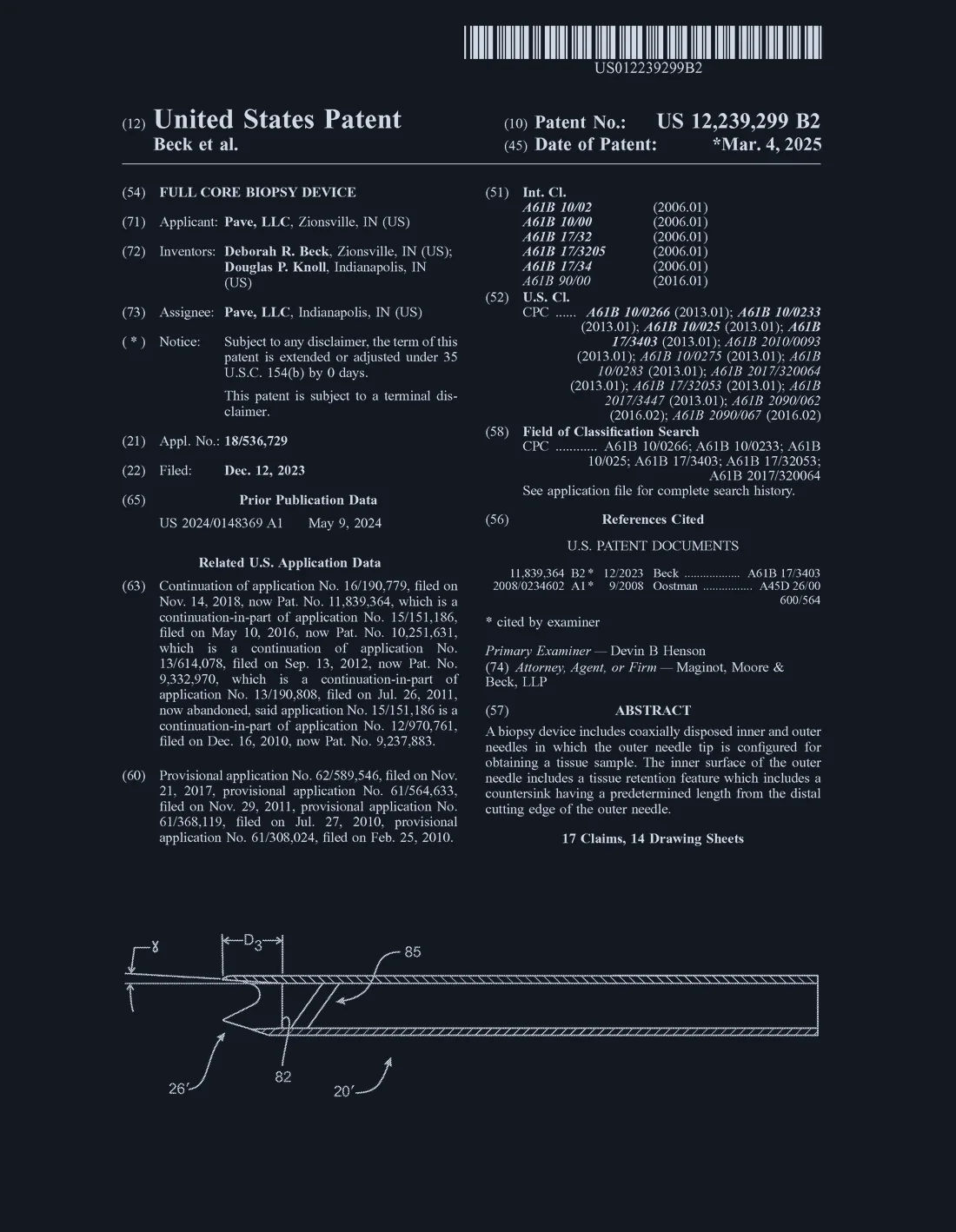
US 12,239,299 B2
FULL CORE BIOPSY DEVICE
Mechanism / explanatory paraphrase
This record describes the same countersink tissue-retention mechanism in its abstract. It is recorded as a continuation of US 11,839,364; the shared abstract alone does not explain differences between the grants’ claims.
- Filed
- Dec. 12, 2023
- Granted
- Mar. 4, 2025
- Family
- Continuation of US 11,839,364
- Inventors
- Deborah R. Beck, Zionsville, IN (US); Douglas P. Knoll, Indianapolis, IN (US)
- Assignee
- Pave, LLC, Indianapolis, IN (US)
Abstract, as granted
A biopsy device includes coaxially disposed inner and outer needles in which the outer needle tip is configured for obtaining a tissue sample. The inner surface of the outer needle includes a tissue retention feature which includes a countersink having a predetermined length from the distal cutting edge of the outer needle.